
Natural Capital & The Energy Transition
From the Factory Floor to Fine Aroma
By DWN-team · Nov 10, 2026 Views: 1,869
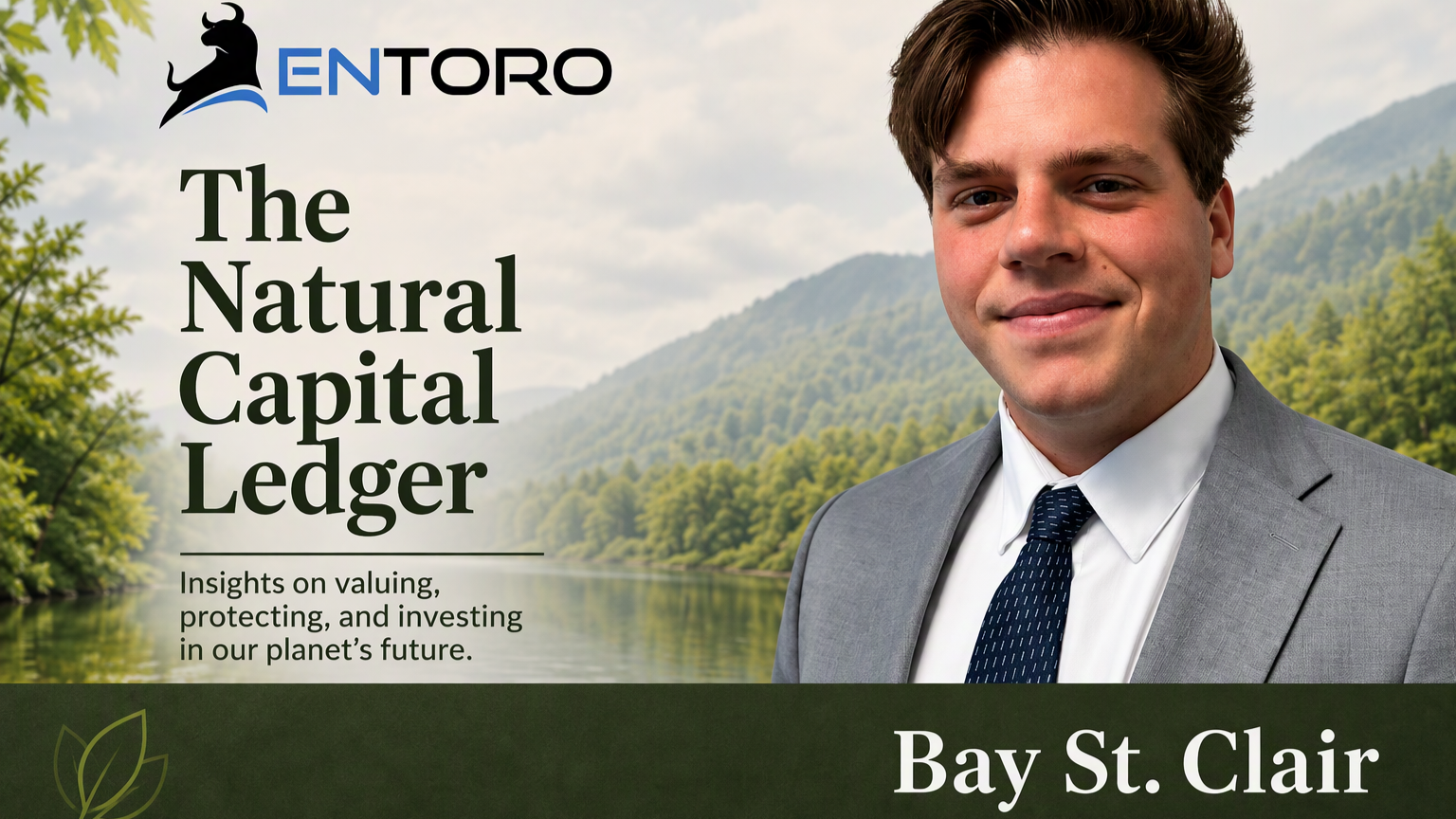
By Bay St. Clair, Associate, Entoro
Constantino Dimitrakis's work started on the factory floor. Over the past three decades, he has run an industrial slaughterhouse in El Salvador, built a coffee roasting plant in Cairo, and set up a commodities trading house in London. Today he is the founder and CEO of Aegean American, which is building a fine-aroma cacao plantation and processing business in Soná, in Panama's Veraguas province.
Cocoa has had a rough few years. According to the International Cocoa Organization, global production fell 12.9% in the 2023/24 season. At the same time, Europe's upcoming deforestation requirements are pushing cocoa buyers toward greater traceability and verification of where their products are grown. I wanted to hear from someone who has spent his career moving agricultural products from the farm to the buyer, and who is now betting on a new origin.
This is the first of two parts. Our conversation is below, edited for length and clarity.
How he got here
Bay: Constantino, thanks for making the time. Let's start at the beginning. You've run a slaughterhouse, a roasting plant and a trading company, in three different parts of the world. What's the thread that connects all of that?
Constantino: Taking what Latin America offers and grows and getting it to buyers around the world with more added value than when it left the farm. Whether it was beef, coffee or cocoa, the value was always in the processing and in the relationships on the other end. Cacao in Panama follows that same idea, just with more control over the whole chain.
Bay: You ran DIKA in El Salvador for twelve years under a government concession, supplying supermarket chains across Central America. What did running a regulated food business teach you that you're still using today?
Constantino: Discipline. When your counterparty is a government agency and your customers are supermarket chains, nothing works without regulatory compliance, traceability, food safety and consistency. You learn that documenting everything is part of the product. That is exactly what European buyers now expect from cocoa, so it feels very familiar.
Bay: Then came Cairo, Egypt. You cofounded and set up the MISR coffee roasting plant and took your brand, Katzala, into Egypt, Saudi Arabia and the UAE. I have to imagine not everything went to plan. What went wrong, and what did you do differently after?
Constantino: Plenty. The market was a bit more price-sensitive rather than quality-focused. I was more quality- and status-driven, but we adjusted on the fly and developed the right coffee for the market. The lesson I took from this experience was to build the people before you build the plant. Training local teams early and planning for delays you can't control saved us more than any piece of equipment did. Also, I found out the hard way that you need to be onsite more often than expected. That is why, for the cocoa project, we as a group and family are relocating to Panama for the long term.
Bay: You've been exporting coffee and cocoa to the UK, Switzerland and Egypt since 2012. What have buyers taught you about what they'll actually pay more for?
Constantino: Consistency and trust. Everyone says they want quality, but what buyers really pay for is knowing that the tenth container will match the first. Traceability and reliability matter more to them than a good story about the origin.
Why cacao, and why own the whole chain
Bay: In 2023 you bought SEPLASA, the nursery, and GRUVASA, the farm-construction company, instead of just hiring them. Why own the nursery and the farm-construction company?
Constantino: Because the plants are everything. If the genetics are wrong, you find out four years later, and there is no fixing it. Owning SEPLASA means every plant comes from certified mother plants that we control. Owning GRUVASA means the people building the farm follow the same quality control standards. In agriculture, you can't outsource the foundation.
Bay: You're already running a 50-hectare fine-aroma cacao project. What has that taught you, and what surprised you?
Constantino: Planning and coordinating our nursery team and farm employees has taught us a lot. The biggest lesson is that intensive management pays off. Irrigation, nutrition and pruning done properly make a visible difference, and good grafted genetics behave the way they are supposed to.
The problem
Bay: About 70% of the world's cocoa comes from just two countries, Côte d'Ivoire and Ghana, and production there has been hit hard by geopolitical unrest, disease, aging trees, and adverse weather. From inside the trade, what's really going on, and do you think it's a few bad seasons or something that lasts?
Constantino: It's structural. Swollen shoot virus has forced farmers to uproot huge areas in Côte d'Ivoire, the trees are old, soils are tired and many farmers don't earn enough to reinvest. You can't fix that in one good season. When two countries supply most of the world, one bad year moves the whole market. Adding to what I said, there is also the traceability issue. There is essentially no traceability.
Bay: Europe's deforestation regulation now requires cocoa to be deforestation-free and traceable to the plot of origin. How has that changed your conversations with offtakers? What are they asking now that they weren't asking a few years ago?
Constantino: The questions used to be about price and volume. Now the first questions are where exactly the cocoa was grown, whether there are coordinates for the plot, and whether we can prove no forest was cleared. Buyers also ask about cadmium and certifications. Supply that can answer those questions is the supply they want.
Bay: So why is now the time to build a new origin?
Constantino: Because buyers are making their sourcing decisions now, and cacao trees take years to come into full production. If you wait until the shortage is obvious to everyone, you are already late. The companies that plant today will be the ones supplying the market when it needs them.
Why Panama
Bay: Ecuador is the name most people think of for fine-aroma cacao. Why Panama, and why Soná?
Constantino: Ecuador is a great origin, and we actually buy beans there today. Panama gives us things that are hard to find together: a dollarized economy, the Canal, free zones for processing and a stable framework for agriculture. Soná has the right rainfall, good soils, road and port access, and our site sits in an enclosed valley, which helps a lot with biosecurity.
Bay: The land you're planting has been cattle pasture for more than 25 years. Why does that matter to a European chocolate maker, and to the land itself?
Constantino: For a European buyer, it means the land has a clean history. It has been pastureland for over 25 years, so there is no question of deforestation. For the land itself, it is a restoration story. We are turning tired grazing land back into a permanent forest system with shade trees, healthier soils and better water management.
Bay: For someone who's never thought about cacao genetics, why do the varieties you've chosen matter and just how different are they?
Constantino: A traditional farm grown from seed is a lottery. Every tree is a little different in yield, flavor and disease resistance. Our trees are grafted from selected, MIDA-certified varieties like ICS-95, IMC-67 and TSH-565, chosen for flavor, productivity and disease tolerance. Every tree is the one we choose, which makes a big difference between a traditional orchard and a high-production, professional plantation.
Bay: Aegean American estimates the project could create more than 1,000 direct and indirect jobs. Where do those jobs actually come from, and what does that mean for the region?
Constantino: They come from the farm itself, the nursery, the processing plant in the free zone, and the transport, logistics and shipping around it. Veraguas is one of Panama's less developed provinces, so formal jobs with social security and proper training matter a great deal. People there already know perennial crops. We want to give them a career in it.
Beyond the Interview
Having visited Panama and seen the nursery and surrounding area firsthand, what stood out to me was the work already underway. It's one thing to discuss developing a large-scale agricultural project on paper and another to see the people, infrastructure, and preparation involved in bringing it to life. There is still a long road ahead, but seeing the operation firsthand gave me a better appreciation for both the scale of the undertaking and the experience required to execute it.
What makes Aegean American interesting is the opportunity it is pursuing. The cocoa industry is facing challenges that cannot be solved overnight, while buyers are becoming increasingly selective about where and how they source their products. Building a new supply operation takes time, capital and patience, but that also creates an opportunity for those willing to invest in the infrastructure before the market fully demands it. Ultimately, the value of this project will depend not just on growing quality cacao, but on turning that production into a reliable, commercially viable supply chain.
In Part 2, we'll look at what it takes to turn that vision into a functioning business, from the economics and execution risks to the opportunities that lie ahead.
Definitions
Fine-aroma cacao: cacao varieties prized for distinctive flavor and aroma, used in premium chocolate and typically sold above bulk cocoa prices.
EU Deforestation Regulation (EUDR): a European Union rule requiring cocoa and other commodities sold in the EU to be deforestation-free and traceable to the plot of land where they were produced.
International Cocoa Organization (ICCO): an intergovernmental body of cocoa-producing and cocoa-consuming countries that publishes global supply and demand statistics.
Grafting: joining a cutting from a chosen variety onto a rootstock, so the tree carries the desired traits from the start.
Nursery: a facility that propagates and grows young plants before they are planted in the field.
Origin: in the cocoa trade, the country or region where beans are grown, which shapes their flavor and how buyers source them.
Disclaimer: The views and opinions expressed in this article are those of the author and do not necessarily reflect the views of Entoro, LLC, or any of their respective affiliates. This article is provided for general informational and educational purposes only and does not constitute investment advice, a recommendation, an offer to sell, or a solicitation of an offer to buy any security, financial product, or investment strategy. The information presented is believed to be reliable but is not guaranteed as to its accuracy, completeness, or timeliness. Any forward-looking statements or opinions are subject to change without notice.
Author Bio: Bay St. Clair is an Associate at Entoro Capital, LLC, focused on structured finance, carbon markets, insurance, and renewable energy transactions. He supports financial modeling, due diligence, automation, and valuation work for climate finance and environmental asset securitization projects.He plays a central role in expanding Entoro’s Natural Capital Securities platform and 1NatCap’s transaction infrastructure. He supports the origination, structuring, and execution of carbon and natural capital securitization projects through the development of Entoro’s automated processes for diligence frameworks, risk-assessment processes, and capital-markets systems required to move projects from initial evaluation through financing and commercialization.
Bay has supported Entoro Insurance Services by preparing research and presentation materials for various carbon credit insurance partnership initiatives. He also worked as a student consultant with CarMax, where he developed a financial and marketing strategy to enhance electric vehicle adoption.
He earned a Bachelor of Science in Commerce with concentrations in Finance and Management from the University of Virginia’s McIntire School of Commerce. He holds FINRA Series 3, 7, 24, 27, and 63 licenses and is a licensed Property and Casualty Insurance Agent in Texas.