
Industry Briefs
The Calendar Is the Enemy When Raising Capital
By DWN-team · Oct 21, 2026 Views: 59

Featured Image: James C. Row
By James C. Row, CFA, Managing Partner, Entoro
Timing can make or break a capital raise. The process takes months, and investors are reliably available only during certain windows of the year, so a raise has to be planned around their calendar rather than the issuer’s. The graphic below maps a typical year: open windows are shown in blue, and the periods when investors are largely unavailable are shown in red.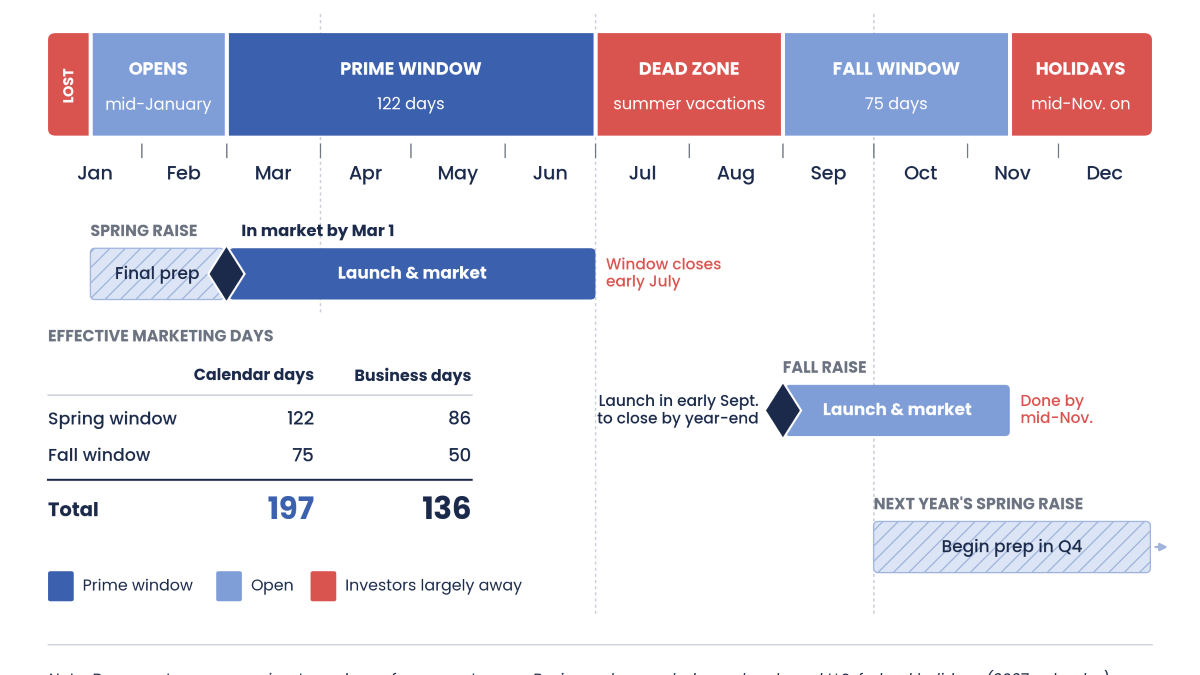
As the graphic shows, the year offers only two real windows to raise capital, and the second is far shorter than the first.
Reading the Calendar
- Timeframe – Fundraising is a long process. Most raises take three to five months, and some take up to a year.
- Optimal Starting Time – The first half of the year has proven to be the best time to begin and execute a raise.
- Winter/Spring Window – The window opens in the second half of January and generally stays open until early July, when investors begin leaving for summer vacations. It is the longest window of the year and usually the most productive. To make the most of it, begin preparing in the fourth quarter of the prior year and be in the market no later than March 1. The 122 days from March 1 to early July are when outreach to investors should be at its most active.
- Total Days – Across the whole year, there are roughly 195 days in which a project can be marketed effectively, or about 140 once weekends are excluded. The spring window accounts for 122 of those days, which is why it tends to be the busiest season.
- Summer/Fall Window – From early July until the beginning of September, investors tend to be out of town and unavailable. That leaves September through mid-November as the last viable window of the year: roughly 75 days, far shorter than the spring window. Because the window is so tight, an offering should launch in early September to have a realistic chance of closing before the holidays, which generally begin in mid-November.
Beyond the Calendar
- Investor Preferences – Investors have high expectations and very specific preferences. Founders and executives naturally see their company, vision, and mission as a cause worth more than anything else, but investors turn down many opportunities for every one they fund. Finding willing investors is hard, and the path to a successful raise is usually longer and more difficult than issuers expect.
- Management Team – Investors weigh the management team heavily. Seasoned teams with extensive experience are far more likely to attract investors’ attention and, ultimately, their capital, so a strong team should be front and center in how the company is marketed. If the founding team has not worked together before and lacks a shared track record of success, investors will typically favor companies with proven teams.
- Time Commitment – Raising capital is also a major drain on management’s time. A CEO fundraising without a banker can expect to spend 60 or more hours a week on it; with a banker, that often drops to roughly 40.
- Fees – Fees for raising capital depend on the size, complexity, and structure of the offering, along with legal work, roadshows, and other factors.
- Expenses – Marketing, roadshows, advisors, and related expenses can range from $100K to $1MM, depending on preparation, outsourcing, the quality of the product, and everything else that goes into a professional raise.
- Expectations – No capital raise is easy, especially with hard but unwritten seasonal deadlines in play, so managing expectations is critical. The issuer knows its project and the investor does not, which means investors must be educated and expectations managed carefully on both sides.
Lessons Learned
- Preparation – Prior planning prevents poor performance.
- Leadership – Management is 50% of the story, and your track record of success matters.
- Simple story – Be able to explain your business or project in 60 seconds.
- Clear message – Keep discussions to three or four points.
- Margin analysis – Be able to clearly articulate your unit economics.
- FAQs – Prepare for the 30 to 40 obvious questions and be ready to answer them.
- Potential risks – Prepare a risk matrix of the top five to eight items that could derail the raise.
Author Bio: James C. Row, CFA, is the Founder and Managing Partner of Entoro Capital, LLC, a middle-market, traditional and alternative investment bank based in Houston, TX. Mr. Row has over 25 years of experience in capital raising, deal structuring and energy finance, including project finance, equity and debt securities, risk management and digital securities. He has originated and arranged funding, in excess of $10 billion. Mr. Row is a Chartered Financial Analyst and maintains Series 7, 24, 28, 63, 79 and 99 FINRA securities licenses. He serves as a member of groups such as the Houston Society of Financial Analysts, Houston World Affairs Council, and Houston Producers Forum, is the author of several oil and gas issues and is a featured speaker at global industry conferences.
Education:
- University of Wyoming – B.S., Finance
- Arizona State University – Master of Business Administration
- American Graduate School of International Management, CAS – Thunderbird