
Real Estate Insider
REAL ESTATE CYCLES AND WHERE WE ARE TODAY
By DWN-team · Oct 22, 2026 Views: 33

By Eli Mills, Equity Catalyst
In 2001, I was a commercial real estate investment advisor at the age of 26. I still remember when the dot-com bubble burst, the US went into a recession, and commercial real estate values dropped from their peak. I remember telling some of my clients that we'd missed the peak as if it was never coming back — and then, five quarters later, those losses had been recovered and the next peak in commercial real estate values was already underway.
At the time, I didn't realize that real estate is cyclical. Values go up and down depending on where things are in the cycle. I also didn't realize that, across the history of the US, real estate values have never gone down without eventually coming back up above the previous peak.
Understanding that real estate is cyclical — and knowing what those cycles look like — is helpful in successfully investing in commercial real estate.
What does a real estate cycle look like?
There are four phases to the commercial real estate cycle: Recovery, Expansion, Hypersupply, and Recession. We can look at a cycle from a few different vantage points —vacancy and new construction is one of the best indicators of market cycles; we will focus on real estate cycles through that lens.
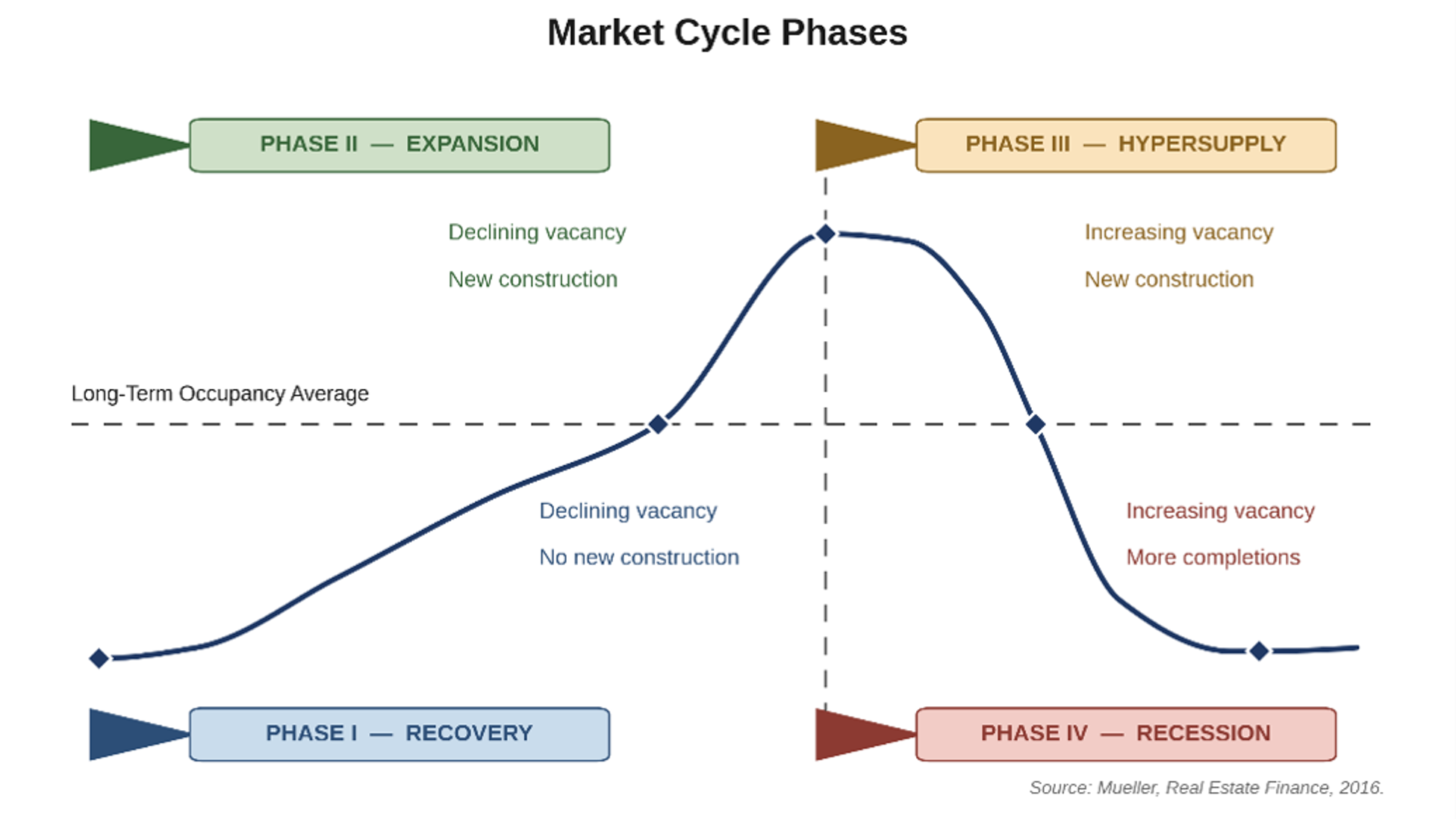
The Real Estate Cycle Explained
Real Estate Cycles start in the Recovery Phase: after a Recession Phase causes property value declines and increased vacancies. In this phase vacancies start declining, there's little to no new construction because occupancies are still well below their long-term average — the market is essentially waiting for vacant space to be absorbed. During this phase, lenders become more likely to lend as they have weathered the storm during the Recession Phase.
As the market strengthens and occupancy climbs back to its long-term average, the cycle shifts into the Expansion Phase: during this phase vacancies continue to decline and occupancy continues to climb, often well above the long-term average. New construction that breaks ground isn’t delivered for 1-3 years causing further increased occupancy above the long-term average. Lenders become more competitive with debt options and existing properties begin to increase in value.
As momentum is gaining and vacancies continue to decline the market kicks into the Hypersupply Phase: new construction ramps up significantly, vacancy starts climbing again, and occupancy drifts back down towards the long-term average. The Hypersupply Phase tends to be overexuberant with a lot of construction occurring, inexpensive and high leverage debt options are available, and property values have likely increased above the previous peak. During this phase the market heats up until it eventually overheats and moves back into the Recession Phase: debt now becomes more expensive and more difficult to obtain, vacancies have gone up and deliveries from the previous Hypersupply Phase continue to deliver. Values go down during the Recession Phase and the market adjusts until the next Recovery Phase can begin.
This cycle plays out again and again. Since I witnessed my first real estate recession in 2001, I've lived through multiple cycles. Some are dramatic, with sharp property value swings like the Great Recession; others are far more subtle.
The visual above looks simple, but there's a lot happening behind the scenes — the vacancy and new construction numbers are really just the visible signal of what's going on underneath.
So where are we today?
Today it appears as if we are at the beginning of the Recovery Phase. The Recession Phase started in late 2022 early 2023 and ran through 2025. The Hypersupply Phase leading to it started around 2019 and ran into early 2022. From 2019-2021 interest rates were at an all-time low, vacancies were below their long-term average, and construction was ramping up significantly. Then, the Fed Funds rate began to rise quickly in 2021 and continued through 2022 climbing about 425 basis points (from 0.25% to 4.5%). This caused interest rates on commercial real estate to double, and values fell dramatically across every product type.
The speed of that rate increase pushed the market into the Recession Phase quickly — by 2023, it was fully underway. Values were down, debt was more expensive and harder to get as lenders were trying to adjust to the market. But a lot of new construction projects had already broken ground and still had one to two years before they delivered.
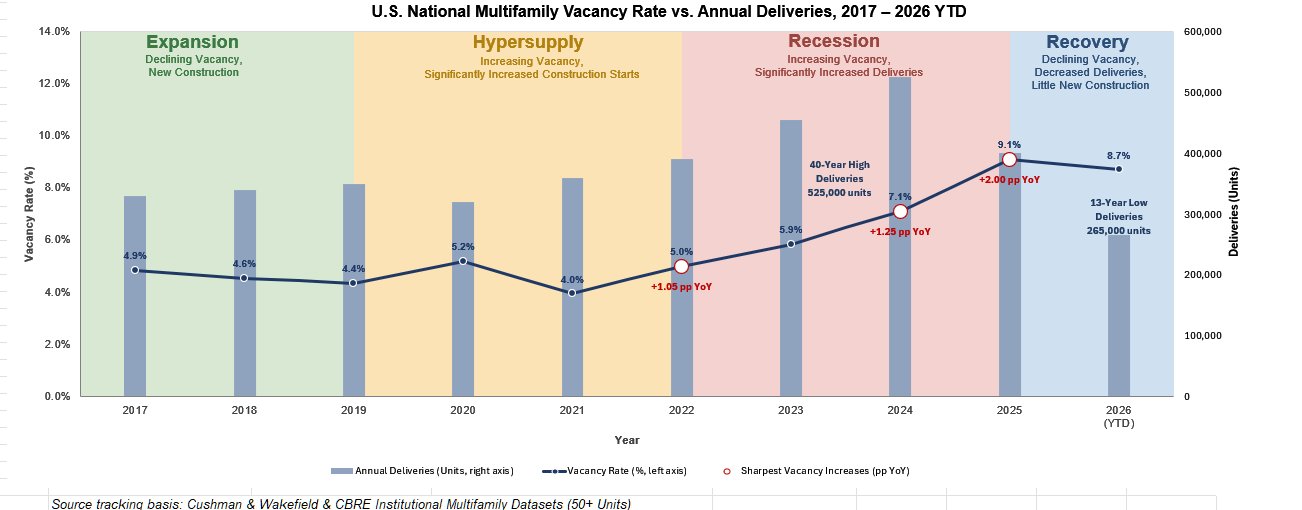
Take multifamily as an example. Back in 2021–2022 at the peak of the Hypersupply Phase, when vacancies were below the long-term occupancy average, developers committed to new projects, lined up financing, and broke ground. With a typical 1–3-year lag between breaking ground and delivering units, those projects delivered to the market from 2023–2025, during the Recession Phase. Those deliveries accounted for a 40-year high in new multifamily deliveries, all delivered during the Recession Phase pushing vacancies up, well below the long-term occupancy rate.
Here's how the current cycle played out for multifamily, looking at vacancy trends:
Source tracking basis: Cushman & Wakefield & CBRE Institutional Multifamily Datasets (50+ Units)
The last 2-3 years have been rough for commercial real estate as we have been in the Recession Phase with record high deliveries and increasing vacancies. However, the good news is that the Recovery Phase appears to have started. Projects that didn’t break ground by 2023 were largely put on hold, and by 2026, multifamily construction deliveries hit a 13-year low. New construction starts are still down significantly which will give the market the time it needs to recovery in preparation for the next Expansion Phase. Due to the reduction in starts and deliveries, we are seeing vacancies fall in 2026 for the first time since 2021. If this trend continues, which it appears as if it will, then we are in the Recovery Phase which will lead to the next Expansion Phase. The graph above shows the macro view of the entire US multifamily market. Some cities and states are stronger than others and are further along in the Recovery Phase and will be entering the Expansion Phase soon.
Insight and advice based on real estate cycles
Some investors think of the real estate cycle as simply a series of good and bad markets. In reality, each phase of the cycle presents a different set of opportunities.
During the Recovery and early Expansion phases, investors are often rewarded for acquiring assets and using reasonable leverage as occupancy rises and values recover. During the Hypersupply phase, opportunities may come from refinancing long-term debt, reducing risk, or harvesting gains from assets that have appreciated significantly. During the Recession phase, investors with available capital and patience can often acquire quality assets at prices that would have been difficult to find just a few years earlier.
Sound advice for every phase of the cycle is “don’t over lever”. If you or a partner is using a high level of debt — above 70% LTV — that's cause for concern. It doesn't leave much room to weather the Recession Phase. Many of the losses that investors experience in commercial real estate come from overleveraging, which we tend to see happening in the Hypersupply Phase right before a Recession Phase kicks in. This is when debt tends to be the easiest to obtain, with the highest loan-to-values available.
The key is understanding that the strategy that works best in one phase of the cycle may not be the strategy that works best in the next. Successful long-term investors adapt their approach as conditions change rather than assuming today's environment will continue indefinitely.
Conclusion
Commercial real estate cycles are inevitable, but they are also remarkably consistent in their broad patterns. Investors who understand where they are in the cycle, use prudent leverage, and align their strategy with the opportunities each phase presents are often in the best position to succeed. No one can consistently predict every the peak and trough, but history shows that patient investors who can weather the downturns and act when opportunities arise are frequently rewarded as the cycle turns and values ultimately move beyond prior peaks. The goal isn't to avoid the cycle, it's to understand it well enough to make better decisions throughout them.
Future insight will be coming in future articles covering: Where are we in the Industrial, Office and Retail Cycles and how to make money investing in commercial real estate developments.
Disclaimer: The views, opinions, and analysis expressed in this article are solely those of the author(s) and Equity Catalyst, and do not necessarily reflect the position or opinions of Gardner Group, Entoro Securities, LLC, Digital Wealth News, or any of their respective affiliates. Securities offered through Entoro Securities, LLC, Member FINRA/SIPC. This article is provided for general informational and educational purposes only and does not constitute investment, financial, legal, or tax advice, nor does it constitute an offer to sell, a solicitation of an offer to buy, or a recommendation for any security, real estate asset, or investment strategy. Commercial real estate investments involve substantial risk, including the potential loss of principal, lack of liquidity, and market volatility. Past performance and market forecasts are not indicative of future results. Readers should consult with qualified tax, legal, and financial professionals before making any investment or strategic capital decisions.
Author Bio: Eli Mills is the CEO of Equity Catalyst, a Gardner family office company dedicated to raising LP equity for commercial real estate developments, acquisitions, and recapitalizations across the United States.
With over 30 years of commercial real estate experience, Eli has closed more than 300 transactions totaling over $4.5 billion in volume. Before joining Gardner, he served as an Executive Vice President with CBRE’s national Institutional Capital Markets team. Known for his data-driven, detail-oriented approach and high integrity, Eli holds a bachelor’s degree from the University of Utah and a joint MBA from Columbia University and UC Berkeley. Outside of his professional endeavors, Eli has been married for 30 years and enjoys spending time with his 8 children and 7 grandchildren, as well as traveling, mountain biking, and boating.